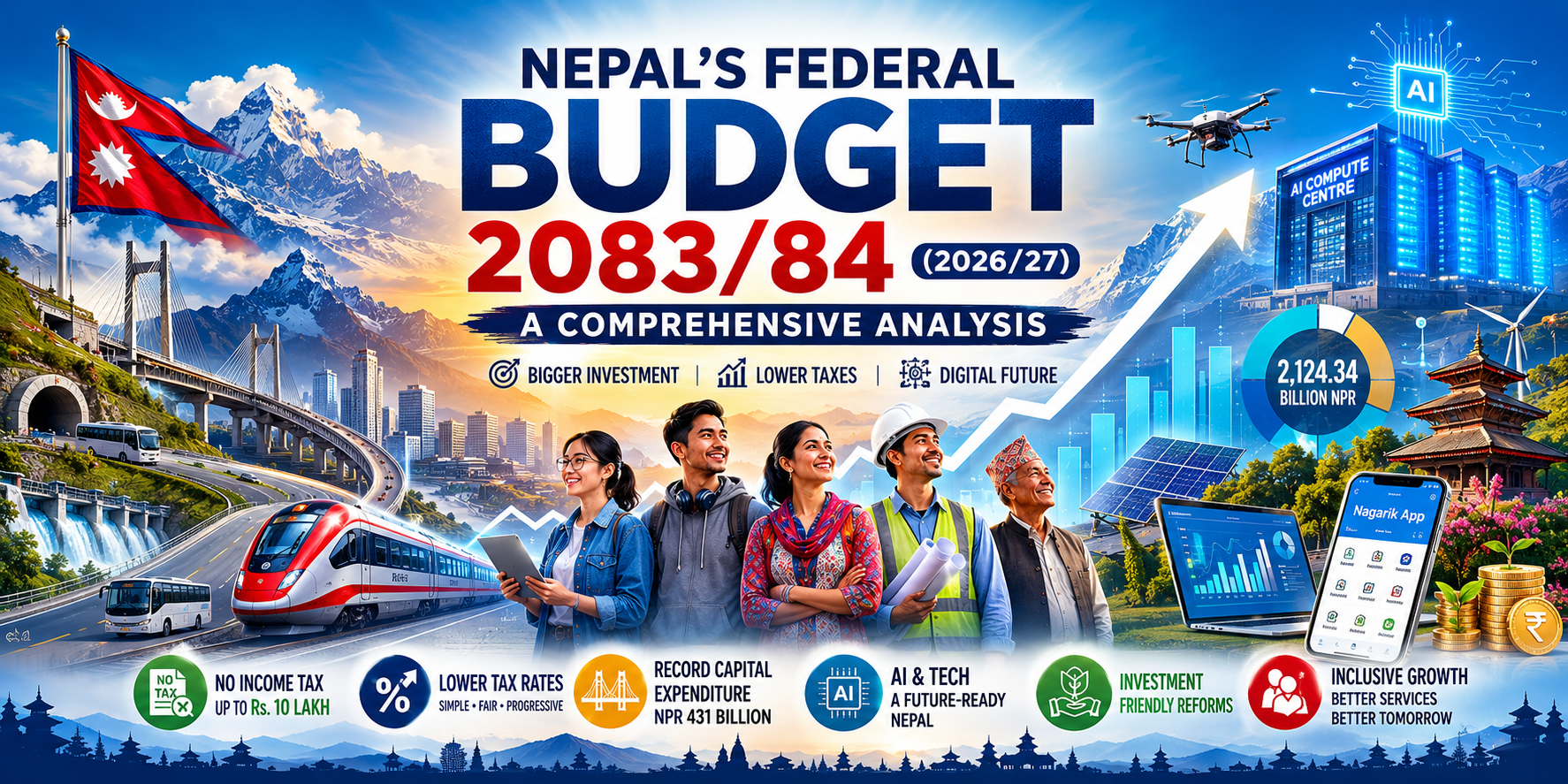
Nepal's Federal Budget 2083/84 (2026/27): A Comprehensive Analysis
Nepal's Federal Budget 2083/84 (2026/27): A Comprehensive Analysis
Introduction
Nepal's Federal Budget for Fiscal Year 2083/84 (2026/27) represents one of the most ambitious and reform-oriented budgets in recent memory. Presented by Finance Minister Mr. Swarnim Wagle, PhD in the House of Representatives and National Assembly on 29th May 2026 (2083 Jeshta 15), the budget is anchored on four core pillars: governance reform, a production-oriented economy, technology-friendly transformation, and equitable economic growth. With a total outlay of NPR 2,124.34 billion, the budget signals a decisive shift toward structural transformation of Nepal's economy, public administration, and tax system.
This article provides a thorough, section-by-section analysis of all the key elements of the budget - from macroeconomic targets and ministry-wise allocations to sweeping amendments in income tax, VAT, excise duty, and customs law.
Part I: Budget Summary
1.1 Economic Growth and Inflation Targets
The budget projects an ambitious economic growth rate of 7% for FY 2083/84, while targeting inflation at 6%. These targets reflect the government's confidence in the reform agenda and its focus on productive investment and capital expenditure.
1.2 Total Budget Size and Composition
The total budget stands at NPR 2,124.34 billion, up from a revised NPR 1,670.18 billion in FY 2082/83 - a significant jump of over 27%.
Sources of Funding:
|
Source |
FY 2083/84 (NPR Billion) |
FY 2082/83 Revised (NPR Billion) |
|
Revenue |
1,405.31 |
1,135.22 |
|
Foreign Grants |
61.74 |
30.99 |
|
Loans and Borrowing |
657.29 |
503.97 |
|
Total |
2,124.34 |
1,670.18 |
Revenue constitutes 66.15% of total funding, foreign grants 2.91%, and loans and borrowings 30.94%. Compared to the prior year, the revenue share has slightly declined while the foreign grant component has almost doubled in absolute terms.
Application of Funds:
|
Application |
FY 2083/84 (NPR Billion) |
FY 2082/83 Revised (NPR Billion) |
|
Recurring Expenditure |
1,270.58 |
1,115.04 |
|
Capital Expenditure |
431.11 |
251.39 |
|
Debt Financing |
422.65 |
329.89 |
|
Total |
2,124.34 |
1,696.32 |
The most striking feature on the expenditure side is the dramatic increase in capital expenditure - from NPR 251.39 billion to NPR 431.11 billion, a rise of 71.5%. Capital expenditure now constitutes 20.29% of the total budget, up from 14.82% in the revised figures of the prior year. Recurring expenditure stands at 59.81% and debt financing at 19.90%.
1.3 Ministry-Wise Budget Allocation
The budget allocates funds across three tiers - central government, provincial, and local level - with the central government receiving the lion's share at 80.03% (NPR 17,000,670 lakhs), provinces receiving 5.16% (NPR 1,096,535 lakhs), and local governments receiving 14.81% (NPR 3,146,239 lakhs).
The top five ministries by allocation are:
- Others (President, Constitutional Bodies, Loan Repayment, etc.) - NPR 8,737,714 lakhs (41.13%)
- Ministry of Infrastructure Development - NPR 3,028,352 lakhs (14.26%)
- Ministry of Education and Sports - NPR 2,183,050 lakhs (10.28%)
- Ministry of Women, Children, Gender and Social Security - NPR 1,226,143 lakhs (5.77%)
- Ministry of Energy, Water Resources and Irrigation - NPR 1,140,282 lakhs (5.37%)
Other notable allocations include the Ministry of Home Affairs at NPR 1,083,293 lakhs (5.10%), Ministry of Health and Food Hygiene at NPR 964,363 lakhs (4.54%), Ministry of Agriculture at NPR 731,221 lakhs (3.44%), and Ministry of Defense at NPR 649,675 lakhs (3.06%).
1.4 Function-Wise Budget Allocation
Looking at expenditure by function across all three tiers of government, general public expenditure commands the largest share at NPR 6,303,897 lakhs at the central level alone. Economic affairs stand at NPR 4,489,492 lakhs in aggregate, followed by social protection at NPR 2,277,672 lakhs, and public peace and safety at NPR 919,682 lakhs. Local governments contribute significantly in general public expenditures (NPR 3,146,239 lakhs) and provinces (NPR 1,096,535 lakhs).
Part II: Major Highlights of the Budget
Tax Relief for Individuals - Doubling the Exemption Threshold
One of the most impactful changes for ordinary Nepalese citizens is the doubling of the income tax exemption limit. The threshold has been raised to Rs. 1,000,000 (one million rupees) for individuals, and the maximum personal income tax rate has been reduced by ten percentage points. This is detailed further under the income tax amendments.
Capital Gains Tax Simplification
Capital gains tax on the sale of securities of listed companies is to be treated as final tax, simplifying compliance for investors in the securities market.
Customs and Excise Rationalization
Customs duties on 273 types of raw materials have been reduced to ensure industrial raw material duties remain at least one tier lower than finished goods. Significantly, the previous eleven-tier customs duty structure has been condensed into seven tiers, reducing complexity.
Excise duty has been abolished on 360 goods. Scattered customs point taxes - including infrastructure development tax and road maintenance and improvement fees - have been consolidated into a single green tax, simplifying compliance.
Digital Payments and VAT Incentives
To incentivize digital payments and invoice culture, a 10% VAT discount at the point of invoice is to be offered for purchases made through digital payment methods. The VAT refund system is to be automated. Lottery-based programs are to be initiated to encourage the issuance and receipt of invoices. A High-Level Advisory Committee is also to be constituted to study and recommend on multi-rate VAT.
Tax Dispute Resolution
A special scheme aimed at resolving long-standing tax disputes allows taxpayers to withdraw court cases upon paying the assessed tax with an additional 1%, with all fees, fines, and interest waived.
IT Sector Incentives
A 50% income tax exemption has been granted on income earned from exporting information technology services. A 100% exemption from taxable income applies to sweat equity received by IT sector human resources. Legal provisions enabling remote work for foreign employers while residing in Nepal are to be enacted.
New Industry Incentives
A 100% income tax exemption for the first 10 years has been extended to new motion picture halls established outside Metropolitan and Sub-Metropolitan cities, and to agricultural processing industries.
VAT exemption has been granted on the import of cold storage, packaging, and testing lab machinery for agricultural processing. Customs duty exemption covers raw materials for manufacturing artificial limbs and disability assistive materials.
Insurance and Housing
Residential building insurance premiums of up to Rs. 10,000 are to be deductible for income tax purposes, doubled from the previous Rs. 5,000.
Third-party vehicle insurance has been raised to Rs. 1 million. Customs duties on electric vehicles are to be levied on an ad-valorem basis, replacing the previous peak-power-capacity system.
Revenue Administration Overhaul
The Department of Revenue Investigation is to be abolished, with its functions devolved to respective sectoral bodies. All businesses with annual transactions above Rs. 100 million and issuing electronic invoices must be mandatorily linked to the Central Invoice Monitoring System (CIMS).
The period for tax audits has been fixed at 3 years (down from 4). An AI-driven e-assessment system is to be developed for risk-based investigation and audits. Digital excise stamps are to be introduced, and an electronic track-and-trace system launched to control excise leakage.
Government Restructuring
The government structure is to be made leaner: 31 entities abolished, 6 merged, 6 transferred, and 18 restructured. Funds saved are to be redirected toward administrative efficiency.
Effective from Shrawan 1, 2083, public servants' initial salary scale has been increased by 10%, with a performance-based monthly incentive of 10% of revised salary introduced - an overall increase of approximately 21% in remuneration. Minimum remuneration (including grades) is set at around Rs. 40,000, rising to over Rs. 1,00,000 at higher scales.
Legal and Investment Reforms
Several significant legal amendments are proposed:
- Company Law to be amended for clearer conflict-of-interest rules and easier company liquidation.
- Bilateral Investment Protection Agreements and Double Taxation Avoidance Agreements to be concluded with additional countries.
- Insolvency Act to be amended for consumers and MSMEs; a Limited Liability Partnership law to be formulated to encourage angel investments into venture capital and private equity funds.
- Industrial Enterprises Act amendment so that notification to the Department of Industries suffices for capacity expansion, ownership changes, and capital increases.
- Foreign Investment and Technology Transfer Act amendment removing the requirement of prior Nepal Rastra Bank approval for investment repatriation.
- Convertible instruments, project-linked funding, and hybrid instruments to be included within the scope of foreign investment.
- Muluki Civil Code to be amended to allow foreign investors to take apartments or residential buildings on long-term lease in designated areas, not exceeding 25% of total units.
- A separate commercial disputes tribunal to be established. Intellectual property protection legislation to be enacted. Credit scoring-based lending for individuals and entrepreneurs to be introduced.
Financial Sector
- Capital to be increased in Rastriya Banijya Bank.
- Nepal Airlines Corporation to be transformed into a company with a strategic partner.
- Shares of National Life Insurance Company and Bishal Bazaar Company to be issued to the public.
- Hydroelectricity Investment and Development Company Limited to be merged with similar institutions to establish a specialized infrastructure entity.
- A National Asset Management Company with special legal powers to be established by end of Poush to manage rising non-performing loans.
- Intraday trading, short selling, and derivatives to be introduced in the securities market in phases.
- A Sovereign Wealth Fund to be operated from a percentage of foreign exchange reserves.
- A Motherland Fund to be established to invest in strategic projects including at least three months of fuel storage and AI factories.
- Offshore bonds in Nepalese currency to be issued in the international market. Clean energy bonds and diaspora bonds to be issued.
- Nepal to be removed from the anti-money laundering Grey List as expeditiously as possible, and sovereign credit rating to be improved.
Infrastructure
- Approximately 1,000 kilometers of roads to be blacktopped and 275 road bridges to be constructed in FY 2083/84.
- 670 MW from hydroelectric projects and 370 MW from solar projects (total 1,040 MW) to be added to the national grid, bringing total installed capacity to 5,535 MW.
- Irrigation facilities extended to an additional 15,800 hectares, bringing irrigated arable land to 64%.
- 70 kilometers of embankments to be constructed and 210 hectares of land reclaimed.
Agriculture and Environment
- The agricultural sector is treated as a top priority for commercial transformation, productivity improvement, and dignified livelihoods.
- Forests and natural resources to be repositioned as a foundation for green industrialization, employment, and import substitution.
Education
- A systemic restructuring based on national school mapping, infrastructure audits, teacher competency tests, and AI and ed-tech readiness assessments.
- Education to be transformed into a School-Centric System with School Management Committees ensuring quality.
- A Clean Toilet Campaign to be launched across all educational institutions.
- The National Qualifications Framework and Recognition of Prior Learning to be enforced, formally recognizing skills of migrant and informal workers.
- A paid internship system to be institutionalized.
Urban Mobility and Tourism
- Vision Kathmandu 2040 implementation to commence, covering underpasses, flyovers, river corridor infrastructure, parks, solid waste management, utility ducts, and undergrounding of electrical wires.
- A Smart Urban Mobility Program in the Kathmandu Valley incorporating electric public buses, charging stations, and smart bus parks. E-mobility services in Pokhara Valley as well.
- Preparations underway for Visit Nepal Year 2085 and Nepal Wellness Year 2027.
- The Civil Aviation Authority to be restructured by Poush, separating regulator and operator roles, to remove Nepal from the EU Air Safety List.
Technology and Digital Economy
- Nepal's first Sovereign AI Compute Center to be established at Syuchatar, Kathmandu, with thousands of AI processing units purchased to provide subsidized compute capacity for entrepreneurs and startups. Clean hydroelectric energy to be transformed into high-value AI compute services.
- Remaining shares of Nepal Telecom (after retaining 66%) to be sold to the public by end of Poush; proceeds to develop Nepal into a Tech Hub.
- A Fintech Marketplace to be established under Nepal Rastra Bank supervision.
- Dozens of government services to be integrated into the Nagarik App.
Diaspora and Non-Resident Nepalese
- Non-Resident Nepalese Citizenship constitutional provisions to be updated under the slogan "Once a Nepalese, Always a Nepalese."
- Non-resident Nepalese to be granted full economic, social, and cultural rights and included in nation-building.
- Legal, technical, and administrative infrastructure to be prepared to enroll Nepalese citizens abroad in democratic processes and guarantee voting rights.
Part III: Key Macroeconomic Targets
|
Target |
Timeline |
|
90% health insurance coverage of Nepalese |
Within 3 years |
|
65% of citizens with access to safe drinking water |
Within 3 years |
|
100% access to safe drinking water |
Within 5 years |
|
Irrigated arable land at 64% |
Upcoming fiscal year |
|
Total installed electricity capacity at 5,535 MW |
End of upcoming fiscal year |
|
Nepal removed from AML Grey List |
As expeditiously as possible |
Part IV: Major Amendments in Tax Laws
4.1 Special Amendments Made by Finance Bill, 2083
The Finance Bill 2083 introduces several special provisions cutting across multiple tax domains:
New Fees and Levies:
- Skill Promotion Fee (Section 14): A 0.5% fee on the sale of gold, silver, and their ornaments and articles to consumers.
- Education Service Fee (Section 15): 3% on foreign currency exchanged for tuition fees for students going abroad for education.
- Education Equity Fee (Section 16): 3% on all fees and charges collected by private educational institutions.
- Health Equity Fee (Section 17): 3% on all service fees collected by private health institutions.
Gen-Z Movement Relief (Sections 26 and 27): Businesses whose uninsured stock was destroyed during the Gen-Z Movement may, upon submitting a loss verification report to the Inland Revenue Office, treat the damaged stock value as cost of goods sold for income tax purposes, and claim input VAT credit. Additionally, businesses damaged during the Gen-Z Movement (buildings, furniture, machinery, equipment) get a 50% exemption on customs and excise duty for goods imported for restoration. Casino businesses unable to operate during the Gen-Z Movement get royalty and renewal fees waived for that period.
Precious Metals Tax Remission (Section 31): Luxury tax on gold and gold jewelry, and VAT on diamonds, gemstones, and precious stones that was required to be collected by sellers but was not collected prior to 2 Bhadra 2082, is automatically remitted. VAT that gold and silver jewelry manufacturers or repairers failed to collect during FY 2082/83 or prior years is similarly remitted, along with associated interest, charges, and penalties.
Expired Industrial Goods Write-off (Section 32): Raw materials, finished goods, or semi-finished goods that have expired or become unfit for use within industrial premises may be written off without claiming an excise duty refund. Destruction must occur on or before end of Poush 2083 in the presence of officials from the District Administration Office, Treasury and Comptroller Office, and the local Chamber of Industry and Commerce.
Damaged Excise Duty Stamps Write-off (Section 33): Excise duty stamps destroyed by fire during the Gen-Z Movement or unfit for other reasons may be written off from records.
Post-Clearance Audit Settlement (Section 34): Customs duty, excise duty, or VAT assessed under post-clearance audits that remain unpaid as of end of Baisakh 2083, or are pending before the Revenue Tribunal, can be settled by paying the full assessed amount by end of Poush 2083, with all penalties and interest waived.
Shipping Container Release (Section 36): Shipping containers held in customs premises for extended periods may be reclaimed by the concerned company without demurrage charges, upon application submitted by end of Mangsir 2083.
Institutional and Organizational Tax Relief (Section 37): Universities, diplomatic missions, development partners, and non-resident persons investing in Nepal are not required to file income returns for fiscal years up to 2082/83 (except for TDS already deducted). Community schools and community health institutions filing a return and paying tax for 2082/83 by end of Poush 2083 are exempted from filing for prior years, with associated taxes, interest, and fees waived.
Non-Profit Institution Tax Waiver (Section 38): Non-profit institutions with a constitutional provision that upon dissolution, assets devolve to the government, are exempt from tax on donations, grants, and gifts for FY 2082/83 and earlier, upon filing an income statement for 2082/83 by end of Poush 2083.
Insurance Agent VAT Waiver (Section 39): Insurance agents who failed to collect VAT for FY 2082/83 or prior periods have all tax, interest, fees, and penalties waived and are not required to file tax returns.
PAN Regularization (Section 40): Three broad amnesty-style provisions:
- Persons who earned taxable income without PAN may obtain a PAN, file returns for FY 2079/80 to 2082/83, and pay tax - with all fees and interest waived; no obligation for prior periods.
- PAN holders who were inactive and did not file for FY 2081/82 or earlier may file for 2082/83 and apply for cancellation or resumption by end of Poush 2083, without filing for prior years.
- PAN holders with earned income who failed to file and pay may do so by end of Poush 2083 with an additional 1%, getting all fees and interest waived.
VAT Liability Settlement (Section 41): VAT-registered persons who failed to collect and deposit VAT may deposit the collectible tax plus 1% additional and file returns for periods up to Chaitra 2082 by end of Poush 2083, getting all interest, fees, and penalties waived.
VAT Waiver on Paneer Sales (Section 42): VAT on outstanding unpaid amounts from past sales of milk-produced paneer (cheese) is waived.
Excise Duty Settlement (Section 43): Persons who engaged in excisable goods transactions but did not collect excise duty may file returns and pay the due amount plus 1% by end of Poush 2083, getting late fees and penalties waived. Lapsed excise licenses may be renewed by paying only the FY 2082/83 renewal fee by end of Ashoj 2083.
Outstanding Tax Settlement (Section 44): Persons with filed but unpaid VAT, income tax, or excise duty liabilities as of 15 Jestha 2083 may pay the outstanding amount plus 1% by end of Poush 2083, with all fees, penalties, interest, and late fees waived.
Assessed Tax Settlement (Section 45): Persons with assessed VAT, income tax, or excise duty outstanding as of 15 Jestha 2083 may pay the outstanding amount plus 1% by end of Poush 2083, with all fees, charges, penalties, and outstanding interest waived. Telecom service providers are excluded from this provision.
Tax Dispute Withdrawal with 1% (Section 46): Taxpayers with tax assessments under administrative review or judicial proceedings as of 15 Jestha 2083 may withdraw such cases and pay the assessed amount plus 1% by end of Poush 2083, with all fees, penalties, and interest waived. This applies to cases pending before the Revenue Tribunal, the Supreme Court, and cases where reassessment is ongoing. Telecom service providers are excluded.
International Organization Employee Amnesty (Section 47): Resident persons employed by UN offices, UN-affiliated organizations, internationally recognized bodies, or foreign diplomatic missions who are not entitled to Vienna Treaty exemptions and failed to file income tax returns may obtain PAN, file returns for FY 2079/80 to 2082/83, and pay tax plus 1% by end of Mangsir 2083, getting all interest and fees waived. No obligation for periods prior to FY 2079/80.
Non-Compliant Companies (Section 48): Companies registered under the Companies Act, 2063 that failed to submit returns, renew registration, or pay taxes may continue or close by paying taxes and fees for FY 2082/83 by end of Ashwin 2083, with all prior-period taxes, fees, and penalties waived.
Revenue Leakage Case Settlement (Section 50): Income tax and VAT cases filed under the Revenue Leakage Investigation and Control Act, 2052 and pending before courts may be withdrawn if the principal liability is paid plus 1% by end of Poush 2083, with penalties waived.
Diplomatic Vehicle Transfers (Section 52): Foreign diplomatic missions or donor agencies may transfer vehicles (not more than ten years old) imported under diplomatic exemption to any body of the Government of Nepal by end of Poush 2083, fully exempt from customs duty, VAT, excise duty, and road maintenance fee.
4.2 Amendments in the Income Tax Act, 2058
Transfer Pricing Framework - A Major New Development:
FY 2083/84 introduces a comprehensive transfer pricing regime for the first time:
- International Transaction (Section 2 Kha1): A new definition covers any transaction of goods, services, finance, or intangible property between a resident and at least one non-resident person, and other transactions affecting income, expense, assets, or liabilities.
- Associated Person (Section 2 Kana 4): The definition is expanded with four new sub-clauses for transfer pricing purposes: entities where another entity controls or benefits from 30% or more of income, capital, or voting rights; entities receiving loans of at least 50% of the lender's total assets; entities earning income largely from another's intellectual property; and entities supplying 90% or more of another's raw materials.
- Safe Harbor Rule (Section 33Ka): Taxpayers with annual controlled transactions up to Rs. 1 billion may opt for a simplified Safe Harbor approach to determine arm's length prices, avoiding detailed transfer pricing studies. Three specific safe harbors are provided: minimum 15% operating profit margin for IT service exports; interest on inter-group foreign currency loans at reference rate plus 200–400 basis points; and maximum 5% profit on total cost for low value-added services. Once elected, the Safe Harbor applies for five consecutive income years.
- Advance Pricing Agreement (Section 33Kha): Nepal introduces the APA mechanism for the first time. The Inland Revenue Department may enter into APAs with taxpayers for determining arm's length prices. Bilateral and multilateral APAs with foreign tax authorities under double taxation treaties are also available. APAs are binding for up to five years and may include a rollback facility for up to four prior income years.
New Exempt Income Categories (Section 10):
Four new categories of exempt income are added:
- Income from disposing of land or private buildings donated free of cost to any tier of government
- Interest income of a financial institution wholly owned by a foreign government, established for non-profit purposes, from loan investments in Nepal
- Income earned by water supply and sanitation consumer organizations registered under the Water Resources Act, 2049
- Income earned by universities established and operating in Nepal
Sweat Equity Exemption (Section 8(3)(Nga)): A new exemption for sweat shares received as employment benefit from information technology industries.
Agricultural Business Definition Broadened (Section 11(6)): The definition of "Agricultural Business" is expanded from crop farming to include fruit cultivation, animal husbandry, fisheries, and beekeeping, allowing more agricultural activities to qualify for tax exemption.
Donation Deduction Limit Increased (Section 12(2)): The maximum deductible donation raised from Rs. 1,00,000 to Rs. 3,00,000. The 5% of adjusted taxable income ceiling remains unchanged.
CSR Deduction Introduced (Section 12Gha): A new section allows deduction of Corporate Social Responsibility expenses up to 1% of total taxable income. Prior to this, CSR expenses had no specific deduction provision under the Income Tax Act.
Cash Payment Limit Tightened (Section 21(2)): The turnover-based threshold is removed; the cash payment limit now applies universally to all persons. The per-transaction cash limit is reduced from Rs. 50,000 to Rs. 25,000. Cash payments exceeding Rs. 25,000 per transaction are not deductible.
Share and Bond Issuance Costs (Section 21(3)): Expenses incurred in issuing shares or debentures are excluded from the definition of "Capital Expenses," meaning they are now treated as revenue expenditures.
Section 47Ka Repealed: The special tax continuity provisions for mergers of banking, financial, and insurance entities are removed. Merging entities are now subject to standard disposal provisions under Section 57.
Section 57 Amended: The deemed disposal rule upon 50% or more ownership change now has additional carve-outs: involuntary transfer to legal heirs upon the death of a beneficial owner, and ownership changes in subsidiary entities resulting from changes in a parent entity.
Hire Purchase TDS Deduction (Section 59(1Ka)): NRB-approved hire purchase entities may now deduct up to 5% of their risk-bearing fund provisions, same as banking entities.
Department Interpretation Final (Section 75(1Ka)): The Inland Revenue Department's interpretation under Section 75(1) is now final (subject to court override).
Broad Information Access Power (Section 82Ka): A new power allows the Department to obtain financial transaction information electronically from any person in Nepal, including their customers, employees, service recipients, and members.
Insurance Agent TDS (Section 88(1)): A new 20% TDS rate on commissions and service fees paid to resident natural person insurance agents (increased from 15%).
TDS on Consumer Committee Payments Removed (Section 89(3Ka)): The 1.5% TDS on payments exceeding Rs. 50 lakhs to consumer committees is repealed.
Final Withholding Tax (Section 92(1)): Certain categories are now deemed final withholding taxes: income/gain of resident natural persons and non-residents who opt not to file income returns on certain foreign currency receipts; service payments; and commissions to insurance agents paid by resident natural persons.
Capital Gains Tax Rate Changes (Sections 95Ka(2)(Ka) and 95Ka(5)):
- Capital gains advance tax on shares of listed companies: increased by 2.5 percentage points. For ownership over 365 days, the rate for resident individuals moves from 5% to 7.5%; for less than 365 days, from 7.5% to 10%.
- Capital gains on land and buildings owned for 5 years or more: increased from 5% to 7.5%.
- Capital gains on land and buildings owned for less than 5 years: increased from 7.5% to 10%.
- New concessional rate of 2.5% for land and buildings disposed through compulsory government acquisition.
- Exemption from capital gains tax when donating land or buildings free of cost to any tier of government.
- Ride-sharing platform operators must collect 1% advance tax on payments to drivers.
Tax Assessment Period Shortened (Section 101(3)): The limitation period for tax assessments reduced from 4 years to 3 years.
Tax Refund Window Extended (Section 113(4)): The window to claim tax refunds extended from 2 years to 5 years.
Electronic Invoice Charges Simplified (Section 119Ka): A simplified two-tier charge: Rs. 5,00,000 for using software that can delete or modify electronic invoice data; Rs. 1,00,000 for other non-compliance with electronic invoicing provisions.
New Income Tax Slabs:
The most significant personal income tax change is the elimination of separate slabs for individuals and couples, with a unified slab and dramatically expanded exemption threshold:
|
Annual Taxable Income |
FY 2082/83 (Old) |
FY 2083/84 (New) |
|
Up to Rs. 5,00,000 |
1% |
— |
|
Up to Rs. 10,00,000 |
— |
1% |
|
Rs. 5,00,001 – 7,00,000 |
10% |
— |
|
Rs. 10,00,001 – 15,00,000 |
— |
10% |
|
Rs. 7,00,001 – 10,00,000 |
20% |
— |
|
Rs. 15,00,001 – 25,00,000 |
— |
20% |
|
Rs. 10,00,001 – 20,00,000 |
30% |
— |
|
Rs. 25,00,001 – 40,00,000 |
— |
27% |
|
Rs. 20,00,001 – 50,00,000 |
30% + 20% surcharge |
— |
|
Above Rs. 50,00,000 |
30% + 30% surcharge (effective 39%) |
— |
|
Above Rs. 40,00,000 |
— |
27% + 2% surcharge (effective 29%) |
The previous slabs started at Rs. 5,00,000 for individuals (Rs. 6,00,000 for couples) with rates reaching 30% plus surcharges of 20–30%. The new structure halves the surcharge (to 2%) and dramatically expands the zero-to-low tax band, effectively providing significant relief to middle-income earners. The 1% base rate does not apply to pension income, persons contributing to pension fund or Social Security Fund, or income of sole proprietorship firms.
Vehicle Tax Rates Increased (Schedule 1, Section 1(13)): Annual vehicle taxes for hire vehicles are increased across all categories. For example, a car up to 1300cc now pays NPR 6,500 (up from 5,500), and a Truck/Bus pays NPR 12,500 (up from 10,500).
Building Insurance Deduction Doubled (Schedule 1, Section 1(16Ka)): The deductible limit for residential building insurance premiums doubled from Rs. 5,000 to Rs. 10,000.
4.3 Amendments in the Value Added Tax Act, 2052
Multiple VAT Rates Enabled (Section 7(1ka)): For the first time, a provision allows the Government of Nepal to establish multiple VAT rates (not exceeding the standard rate) and prescribe taxable goods and services via the Nepal Gazette. This is a foundational amendment enabling differentiated VAT treatment in future.
5% VAT on Ride-Sharing and Electricity (Section 7(1kha)): Persons providing ride-sharing services through a registered platform and persons providing electricity services to end users are required to assess and collect 5% tax on taxable value.
VAT Collection Obligation on Ride-Share Platforms (Section 8(2kha)): Ride-sharing platform operators are responsible for assessing and collecting VAT at the point of transaction from ride-share service providers registered on their platform.
Digital Invoice Provisions Strengthened (Section 14(ka)): The Department now sets standards and procedures for digital invoicing for any person issuing invoices through digital means. Designated taxpayers may be required to register in the Central Bill Monitoring System (CBMS) and issue digital invoices either through their own system or through a billing system provided by the Department.
Tax Return Amendment Window (Section 18(4)): A new provision allows taxpayers to amend submitted tax returns within 7 days of submission, following prescribed procedures.
Digital Payment VAT Rebate (Section 25(1kha)): The earlier provision for a 10% refund of VAT on purchases made via digital payment is changed from "refund" to "immediate rebate," signaling a shift to real-time discount at point of purchase rather than a later refund process.
Deletion of Excess Tax Refund on Contracts (Section 25(Ga1)): The provision for refunding excess tax paid under contracts is deleted.
Increased Fines:
- Fine for violations of VAT Act or Rules increased 10-fold from Rs. 1,000 to Rs. 10,000 per occurrence (Section 29(1Ta)).
- New fine of Rs. 50,000 per occurrence introduced for violations of Department directives on internal transfer of commercial goods (Section 29(1Da)).
- Existing fine structure for digital invoice tampering maintained at Rs. 5 lakhs, with a new additional Rs. 1 lakh fine for other non-compliance under the same provisions.
Clarity on Department Interpretation (Section 32kha(4)): Department interpretations are deemed final unless overruled by a court.
4.4 Amendments in the Excise Duty Act, 2058
Expanded Definitions:
- Digital Excise Ticket: The existing definition of "any symbol" is expanded to "any symbol or digital excise ticket," paving the way for digital excise administration.
- Tobacco and Nicotine-Containing Products: The definition is substantially broadened from traditional tobacco products to include electronic cigarettes (vapes), nicotine pouches, hookah flavors, pan masala, gutkha, khaini, and any other product the Department may designate. This significantly widens the excise tax net.
- Liquor (Madira): The definition is expanded to include vermouth, mixed-liquor drinks, ready cocktail, carbonated wine, madira, spirits, syandidis, and other substances declared by the Department, in addition to the existing list.
- Risk-Based Selective Clearance Control System: A new concept defined as a system under the physical control regime where establishments are selected based on risk analysis, with limited supervision of an Excise Officer.
Natural Disaster Coverage (Section 3Ka): Excise duty paid on goods lost due to fire, theft, accident, destructive incident, or expiry may be deducted - now broadened to include natural disaster. However, auxiliary raw materials and packaging materials are removed from deductible items.
Micro-Brewery Advance Payment: Monthly excise duty for micro-breweries must be paid in advance based on a prescribed yield rate from installed production capacity.
Restriction on Sales to Non-VAT Retailers (Section 4D): Industries are now restricted from selling to retailers who are not VAT-registered.
License Scope Expanded: The license restriction on bidi, tobacco, khaini, paan masala, and gutkha is broadened to cover production, export, import, sale, or storage of madira, tobacco-based, and nicotine-containing goods.
Track and Trace System (Section 10Ta1): A new provision empowers the Department to implement a comprehensive electronic Track and Trace system for monitoring production, storage, export, sale, distribution, and movement of madira and tobacco-based goods. Non-compliance with Track and Trace is now an explicit offence.
0.5% Alcohol Tolerance Threshold: A 0.5% alcohol content variance threshold is introduced for all stages of madira production and export.
Increased Penalties (Section 16):
- General fine per occurrence: increased 10-fold from Rs. 1,000 to Rs. 10,000.
- New fine of Rs. 50,000 per occurrence for unauthorized movement of goods violating departmental commercial directives.
- Vehicle used in offence without owner's permission: owner fined Rs. 25,000, driver fined up to Rs. 15,000 or imprisoned for up to 3 months.
Health Risk Tax (Section 22Ka): Health risk tax applicable under the Finance Act is now explicitly incorporated.
New Power to Issue Directives and Standards (Section 25Ka): The Department is now empowered to issue directives and establish standards for production, excise quality, and sale/distribution for madira, tobacco-based goods, and other excisable goods.
Full Schedule Replacement: The entire Excise Duty Rate Schedule is replaced for FY 2083/84. Excise duty on cigarettes, liquor, and beer has been increased by up to approximately 10%.
4.5 Amendments in the Custom Duty Act, 2081
Auxiliary Raw Materials: Sections 14, 15, and 16 are amended to replace "raw materials" with "raw materials or auxiliary raw materials (including packing materials not produced in Nepal)," broadening the scope of raw material-related customs provisions.
Administrative Review (Section 28A): A new provision allows persons dissatisfied with a customs officer's decision to file an administrative review and appeal under prevailing customs law.
Silver Import Provisions (Annexure 4, Section 1): New provisions govern customs duty on silver brought by returning passengers - duty is levied on silver up to 500 grams at the prevailing rate. Silver jewelry up to 500 grams is duty-free; amounts above 500 grams are taxed at the prevailing rate.
Gold and Silver Ornament Transit Facility: Foreign passengers and non-resident or overseas Nepalese with permanent residence permits who bring gold and silver ornaments exceeding the prescribed quantity may deposit them in transit at the Customs Office, receive a receipt, and collect them on return from Nepal.
TV Import Limit Expanded: The allowed duty-free television size for travelers who have lived abroad for at least 12 consecutive months is increased from 32 inches to 65 inches.
4.6 Amendments in the Custom Act, 2082
Small Customs Offices (Section 5): Small customs offices are now placed under the jurisdiction of the main customs office, with a new sub-section (1a) formalizing this structure.
Declaration Amendment Procedures (Section 20): Language tightened to make amendments mandatory rather than permissive: "may allow amendment" changed to "may amend." The restriction clause changed from "no amendment shall be permitted" to "shall not be amended."
Confiscation Rules (Section 53): The section is replaced with a clearer provision: all items (including packaging) must be seized when a confiscation decision is made. However, the vehicle or means of transportation used to transport such goods shall not be seized - unless the owner cannot be found and no claim is made on the notice issued.
Advance Ruling Application Fee (Section 68): A fee of Rs. 3,000 is prescribed for submitting an advance ruling application, enabling importers to receive a binding advance ruling from the Director General before goods physically arrive in Nepal.
Fines for Non-Motorized Vehicles (Section 70): New provisions introduce fines for unlicensed movement of goods: up to Rs. 10,000 for carts, horse-drawn carriages, handcarts, rickshaws, or bicycles; up to Rs. 20,000 for scooters and motorcycles.
Declaration Fine Reduced (Section 71): The fine for making a declaration without disclosing details that would clearly identify goods is reduced from 50% to 25% of the duty payable. A word "intentionally" is added to the clause on attaching false documents, requiring intent to be proven for penalties.
Application for Review Without Prepayment (Section 93): The requirement to pay fees and fines before submitting an application for review against an order is removed.
Forged Government Documents (Section 109): A new requirement that if a forged government document is identified during re-examination, it must be sent in writing to the concerned body or officer for necessary action under prevailing law.
EXIM Code Cancellation Process (Section 114): The automatic cancellation of export or import code numbers for non-renewal is replaced with a proactive application-based process. Businesses wishing to close or cancel their EXIM code must apply to the Department and pay the renewal fee.
Conclusion
Nepal's Federal Budget 2083/84 is a landmark document that reaches far beyond traditional revenue and expenditure planning. It introduces Nepal's first formal transfer pricing regime with Safe Harbor Rules and Advance Pricing Agreements, dramatically reduces and simplifies personal income taxes, and provides broad-based amnesty to bring non-compliant taxpayers and businesses into the formal system. On the macroeconomic side, it commits to significant capital investment in infrastructure, energy, agriculture, and digital infrastructure, while restructuring the government for greater efficiency.
The budget reflects Finance Minister Swarnim Wagle's vision of an economy at a structural inflection point - one that is moving from consumption-driven growth toward production, exports, and technology-enabled services. Key enablers include digital payment incentives, AI compute infrastructure, fintech regulation, and foreign investment liberalization. The social commitments - 90% health insurance in three years, near-universal drinking water in five, and education system transformation - round out an ambitious but comprehensive policy agenda.
Whether Nepal can translate these ambitious targets into ground-level outcomes will depend on the quality of implementation, the pace of institutional reform, and the government's ability to absorb the significantly increased capital expenditure budget effectively.
This article is based on the Highlights of the Federal Budget of Nepal for FY 2083/84), extracted from Budget Speech 2083/84 and Finance Bill 2083. It is intended for informational purposes and does not constitute legal or professional advice.